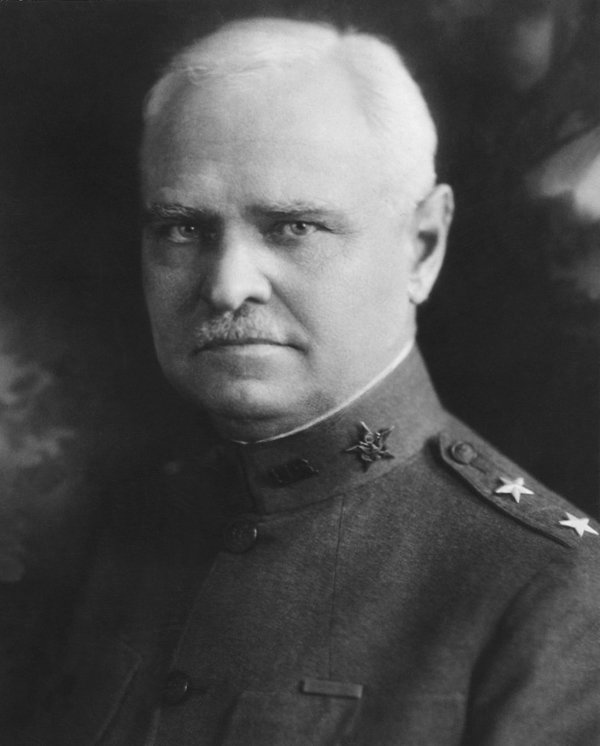
Son of Judge and Mrs. William Ridley., Clarence S. Ridley was born on June 22, 1883 in Corydon, Harrison County, Indiana. Following initial studies in his native state, entered the West Point Military Academy on July 11, 1901 He graduated with high honors, ranking fourth in his class of 114 cadets and was appointed Second Lieutenant in the Corps Engineers of the United States on June 13, 1905.
After making their service trips to Fort Leavenworth and Fort Riley, during 1905 and 1906, he was sent to Cuba in February 1907 for about four months. On his return he was promoted to Lieutenant on 9 June of that year. The following year he graduated from the Engineering School at Washington Barracks. From 1909 to 1912 he served with the troops on the islands of Hawaii and the Philippines, as well as at Fort Leavenworth.
In October 1912, at the age of twenty-nine, he reached the rank of Captain and was assigned to work of river and harbor in North Carolina where he was responsible for the construction of two sets of locks and dams, and then around the work of both river and dock at the Washington district of North Carolina. In 1915 he married Edna E. Taft.
In 1916 he was assigned to the office of the Chief of Engineers in Washington, DC, where he led the development of Engineers Officer Corps Reservists. He was promoted to Major in 1917, and in August of that year he was temporarily appointed to the office of Lieutenant Colonel. In October 1917, he was appointed Colonel and Adjutant Major Military Age of President Wilson, and also supervised the care of public buildings and grounds in Washington, DC His duties included the construction of Arlington Cemetery in Arlington Memorial and the Lincoln Memorial in Potomac Park. He also served as executive officer of the National Commission of Fine Arts, and a member of the First Committee of the District of Columbia area.
While still serving as Adjutant of the President, was awarded the rank of Officer of the Order of Leopold by the late King Albert of Belgium at the White House on October 30, 1919.
He reached the isthmus in May 1921 to assume his duties as Assistant Maintenance Engineer. Ridley had the opportunity to address many of the departments of the Canal in time when the organization was entering a period of established operations and maintenance. Ridley was appointed Governor of the Panama Canal Zone on August 27, 1936, a position he held until 1940 Under his tenure, the application of the laws of the United States of measurement of the vessels as a factor in the Panama Canal tolls boat was abolished on August 24, 1937, and the rules of the Panama Canal was established as the only means of measurement to determine the Panama Canal tolls for boats. The Pacific entrance of the Canal was made more profound and complete, digging more than eleven million cubic yards from the Miraflores Locks up sea buoys, including the Inner Harbor Balboa.
Ridley retired on June 30, 1947 and died on July 26, 1969 in Carmel, California.
domingo, 10 de agosto de 2014
JULIAN L. SCHLEY
Julian L. Schley was born in Savannah, Georgia, on February 23, 1880. His parents were Julian Larcombe Schley and Eliza. In 1898, he graduated from the Lawrenceville School (NJ), and in 1903, the Military Academy at West Point United States. He graduated in 1908 from the Academy of States, of the School of Engineering. In 1903 he was appointed Second Lieutenant in the Army Corps of Engineers of the United States; was promoted in rank to climb the October 17, 1926 the Lieutenant Colonel. From 1909 to 1912 he was an instructor at the Military Academy of the United States. From 1912 to 1913 he was assistant engineer Commissioner DC; from 1917 to 1918 he was commander of the fourteenth Sieteavo Engineering Regiment and later, during World War II, the Fifth Corps of the Army Corps of Engineers; from 1919 to 1921, he was director of purchasing and member of the War Claims Department; from 1916 to 1917 he was in charge of river and harbor improvements in the vicinity of New Orleans; from 1928 to 1932 he was a maintenance engineer in the Panama Canal. In 1931 he married Denise Vary.
Schley was appointed as Governor of the Panama Canal Zone in 1932 From 1916 to 1928 he was in charge of important works on rivers and harbors in Nashville and Galveston and had great knowledge and experience in applied hydraulics. Under his tenure, he began and completed construction of the Madden Dam, which created a reserve of additional water to the Canal which would provide for future expansions traffic.
Governor Schley, like Governor Walker, was a quiet man whose interest in the Canal and its progress absorbed him completely. He spent long hours at his desk, whether early or late, solving problems, answering each question on development and improvements to its last detail. He not only looked the material needs of the Panama Canal, but also the human side of forward progress.
Schley had anticipated the need to build and maintain a workforce of the highest quality as well as maintained the highest standards in materials and equipment Canal. To this end, he brought more trained to work organizations Canal and instituted a training program to prepare young men in skills and abilities and thus serve as potential future male workers.
As Morrow, Schley faced the bitter task of reorganization. A reduction in force was necessary in view of the worldwide depression and the consequent lowering of tolls in respect of navigation. He fulfilled this task judiciously, cutting here and there, yet at the same time, never desmejorando or impairing the efficient organization of the Canal. This was a job that required care and judgment.
During his tenure as Governor, and the Thatcher Ferry Road were inaugurated on 1. September 1932; the Canal Zone College was inaugurated on September 25, 1933, Christopher High School was completed in 1933; plans for a new neighborhood in Gatun was approved; President Franklin D. Roosevelt visited the isthmus on July 11, 1934 and October 16, 1935 A three-cent stamp Goethals went on sale August 15, 1935 Schley retired on 30 September 1941 died on March 29, 1965.
Schley was appointed as Governor of the Panama Canal Zone in 1932 From 1916 to 1928 he was in charge of important works on rivers and harbors in Nashville and Galveston and had great knowledge and experience in applied hydraulics. Under his tenure, he began and completed construction of the Madden Dam, which created a reserve of additional water to the Canal which would provide for future expansions traffic.
Governor Schley, like Governor Walker, was a quiet man whose interest in the Canal and its progress absorbed him completely. He spent long hours at his desk, whether early or late, solving problems, answering each question on development and improvements to its last detail. He not only looked the material needs of the Panama Canal, but also the human side of forward progress.
Schley had anticipated the need to build and maintain a workforce of the highest quality as well as maintained the highest standards in materials and equipment Canal. To this end, he brought more trained to work organizations Canal and instituted a training program to prepare young men in skills and abilities and thus serve as potential future male workers.
As Morrow, Schley faced the bitter task of reorganization. A reduction in force was necessary in view of the worldwide depression and the consequent lowering of tolls in respect of navigation. He fulfilled this task judiciously, cutting here and there, yet at the same time, never desmejorando or impairing the efficient organization of the Canal. This was a job that required care and judgment.
During his tenure as Governor, and the Thatcher Ferry Road were inaugurated on 1. September 1932; the Canal Zone College was inaugurated on September 25, 1933, Christopher High School was completed in 1933; plans for a new neighborhood in Gatun was approved; President Franklin D. Roosevelt visited the isthmus on July 11, 1934 and October 16, 1935 A three-cent stamp Goethals went on sale August 15, 1935 Schley retired on 30 September 1941 died on March 29, 1965.
HARRY BURGESS
Harry Burgess was born in Starkville, Mississippi, on February 22, 1872, his parents were James and Susan Foster Burgess. He was a student of the School of Mechanical and Agriculture of Mississippi from 1888 to 1891, then graduated from the Military Academy of the United States West Point in 1895.Fue instructor in engineering from the Academy at West Point from 1898-1900, then worked in the Corps of Engineers of the United States Army with the rank of colonel in July 1 1920.Burgess was in charge of studies and project design development energy Muscle Shoals, Alabama and maintenance engineer Channel Panama from 1924 to 1928 in 1912 he married Mary Lillington Mckoy.
Burgess was appointed Governor of the Panama Canal Zone in October 1928, and served in that post until 1932 During his tenure, the channel traffic volume increased rapidly and steadily until it reached the limit in 1929 This emphasized the need identified by Walker, to provide an efficient service for a great future traffic and much of the Governor Burgess efforts were directed toward that goal.
Burgess saw the need for preliminary work in order to increase channel capacity with the construction of a dam for water storage needed for channel operation, and maintenance of the water level in Lake Gatun.
Governor Burgess was a very gentle man, and always maintained great sympathy among people under his command. He was affable and really understand the needs and problems of employees. He took great interest in the lives of the people doing the work of operation and maintenance of the canal, and identified closely with workers more than they could imagine themselves.
As an example, he worked very hard, (and much instructed in this), for the rights of the Retirement Act of the Canal Zone, which favorably affected every employee of the waterway. Burgess also planned the construction of school buildings, rooms for singles and nurses and established a public library and the College of the Canal Zone. Unlike his predecessor, Burgess was leaning all the details and saw that all problems should be addressed to him well studied and carefully analyzed and then make quick decisions and good judgment. His term as Governor of the Canal Zone ended in 1932, and the news of his death on March 18, 1933, was received with deep regret among workers Channel.
Burgess was appointed Governor of the Panama Canal Zone in October 1928, and served in that post until 1932 During his tenure, the channel traffic volume increased rapidly and steadily until it reached the limit in 1929 This emphasized the need identified by Walker, to provide an efficient service for a great future traffic and much of the Governor Burgess efforts were directed toward that goal.
Burgess saw the need for preliminary work in order to increase channel capacity with the construction of a dam for water storage needed for channel operation, and maintenance of the water level in Lake Gatun.
Governor Burgess was a very gentle man, and always maintained great sympathy among people under his command. He was affable and really understand the needs and problems of employees. He took great interest in the lives of the people doing the work of operation and maintenance of the canal, and identified closely with workers more than they could imagine themselves.
As an example, he worked very hard, (and much instructed in this), for the rights of the Retirement Act of the Canal Zone, which favorably affected every employee of the waterway. Burgess also planned the construction of school buildings, rooms for singles and nurses and established a public library and the College of the Canal Zone. Unlike his predecessor, Burgess was leaning all the details and saw that all problems should be addressed to him well studied and carefully analyzed and then make quick decisions and good judgment. His term as Governor of the Canal Zone ended in 1932, and the news of his death on March 18, 1933, was received with deep regret among workers Channel.
MERIWETHER L. WALKER
Meriwether Lewis Walker was born in Lynchburg, Virginia, September 30, 1869 His parents were Thomas and Catherine Lidsay Dabney Walker. He graduated in 1893 from the Military Academy of the United States West Point in 1896 and graduated from the School of Military Engineering of the United States. He was director from 1912 to 1914 the School of Army Field Engineering and professor of practical military engineering at West Point from 1914 to 1916 He married Edith B. Carey in 1904.
Walker was appointed chief engineer for Expeditions Punitive to Mexico from 1916 to 1917 he traveled to France as chief engineer of the American Expeditionary Forces from August 1918 to August 1919, then continued as an instructor at the War College Army 1919-1920. he was promoted to colonel on July 1, 1920.
Walker was chief engineer of the Panama Canal from 1921-1924 before serving as Governor of the Canal Zone on October 16, 1924 He worked in that position until 1928.
Of all the governors Walker Channel was probably the most stayed away. It was a quiet, rather reserved, but completely absorbed in his work man. For this reason probably was not as close to their workers as Morrow and Goethals, but his men regarded him as an absolutely fair and just person in all things, acting as the case without hesitation. It was a man "all business," said his men. As Goethals, was a man of prodigious memory, his mind retained the smallest details, those easily forgotten.
Canal traffic volume grew during his tenure, and he foresaw the need for future expansion. His was the foresight to see the need for additional reserve somewhere in the hills of Alto Chagres. In fact, in 1925 he led Illinois Congressman Martin B. Madden to the jungles of Alhajuela and indicated the possible sites for the construction of the dam, where he later built one, which was named in his honor by the support you gave to the project.
Meanwhile Walker worked in the deepening of the sea in the Balboa Pier and watched for municipal operations will continue in accordance with the growing population of employees and their families and the growth of the terminal cities of Panama and Colon, initial steps were taken to control flooding of the Chagres River and an auxiliary power plant was built in Miraflores. The cleanup program in Gaillard Cut dredges provided handling growing traffic. Walker died on July 29, 1947.
Walker was appointed chief engineer for Expeditions Punitive to Mexico from 1916 to 1917 he traveled to France as chief engineer of the American Expeditionary Forces from August 1918 to August 1919, then continued as an instructor at the War College Army 1919-1920. he was promoted to colonel on July 1, 1920.
Walker was chief engineer of the Panama Canal from 1921-1924 before serving as Governor of the Canal Zone on October 16, 1924 He worked in that position until 1928.
Of all the governors Walker Channel was probably the most stayed away. It was a quiet, rather reserved, but completely absorbed in his work man. For this reason probably was not as close to their workers as Morrow and Goethals, but his men regarded him as an absolutely fair and just person in all things, acting as the case without hesitation. It was a man "all business," said his men. As Goethals, was a man of prodigious memory, his mind retained the smallest details, those easily forgotten.
Canal traffic volume grew during his tenure, and he foresaw the need for future expansion. His was the foresight to see the need for additional reserve somewhere in the hills of Alto Chagres. In fact, in 1925 he led Illinois Congressman Martin B. Madden to the jungles of Alhajuela and indicated the possible sites for the construction of the dam, where he later built one, which was named in his honor by the support you gave to the project.
Meanwhile Walker worked in the deepening of the sea in the Balboa Pier and watched for municipal operations will continue in accordance with the growing population of employees and their families and the growth of the terminal cities of Panama and Colon, initial steps were taken to control flooding of the Chagres River and an auxiliary power plant was built in Miraflores. The cleanup program in Gaillard Cut dredges provided handling growing traffic. Walker died on July 29, 1947.
Chester Harding
Chester Harding was born in the town of Enterprise in Mississippi on December 31, 1866 His early education was made in private schools and of course taking the engineering, he attended the University of Alabama, where he graduated with a degree in engineering 1884.
Then he was selected for the Military Academy at West Point United States, and after his graduation June 12, 1889, he was commissioned as a second lieutenant in the Additional Army Corps of Engineers of the United States. On 12 August 1890 he was promoted to Second Lieutenant of Engineers on 26 January 1895 he was promoted to Lieutenant, and July 5, 1898 received the ascent of Captain. Harding was appointed division engineer of the Division of Gatun Locks in 1907, then was promoted to Maintenance Engineer of the Panama Canal in 1915, He served as Governor of the Canal Zone January 1917-1921.
As an engineer of the Panama Canal, Harding was responsible for many construction projects including terminal facilities; operations of the division of buildings including the continuation of the group of buildings Ancon Hospital; the garbage incinerator in Balboa and industrial background to the Panama Railroad; construction dock in Cristobal No.6; and intermittent dredging work in the Culebra and Cucaracha Court because of landslides, removing more than five million cubic yards of soil in five years.
Major Harding married Flora Krum on July 15, 1895 in St. Louis, Missouri. They had three children: Horace, Krum Chester and Katherine. Harding died on November 11, 1936.
Then he was selected for the Military Academy at West Point United States, and after his graduation June 12, 1889, he was commissioned as a second lieutenant in the Additional Army Corps of Engineers of the United States. On 12 August 1890 he was promoted to Second Lieutenant of Engineers on 26 January 1895 he was promoted to Lieutenant, and July 5, 1898 received the ascent of Captain. Harding was appointed division engineer of the Division of Gatun Locks in 1907, then was promoted to Maintenance Engineer of the Panama Canal in 1915, He served as Governor of the Canal Zone January 1917-1921.
As an engineer of the Panama Canal, Harding was responsible for many construction projects including terminal facilities; operations of the division of buildings including the continuation of the group of buildings Ancon Hospital; the garbage incinerator in Balboa and industrial background to the Panama Railroad; construction dock in Cristobal No.6; and intermittent dredging work in the Culebra and Cucaracha Court because of landslides, removing more than five million cubic yards of soil in five years.
Major Harding married Flora Krum on July 15, 1895 in St. Louis, Missouri. They had three children: Horace, Krum Chester and Katherine. Harding died on November 11, 1936.
JAY JOHNSON MORROW
Jay Johnson Morrow was born in Fairview, Virginia on February 20, 1870 He graduated from the Military Academy at West Point United States in 1891, where he received his assignment in the Corps. He graduated from the School of Engineering Applied en1894. He married Harriet M. Butler in 1895 and had no children (she died in 1935 and his ashes were scattered in the Chagres River). The next three years in the service were spent as an instructor of military engineering practices in West Point, then in 1898, he was sent to the Philippines where he served as military governor of the Province of Zambona 1901 to 1902 he worked as Commissioner of Engineering in the District of Columbia from 1907-1909.
Morrow served as Governor of the Panama Canal Zone from 1921 to 1924 President Harding appointed him to fill the vacancy that resulted following the resignation of Colonel Chester Harding.
In his first mission to the Panama Canal Zone I came appointed as a maintenance engineer from 1916 to 1917, and served as Acting Governor. This work was interrupted when the United States entered the First World War. Morrow arrived in France on May 12, 1918, head of the First American Army Engineer and Deputy Chief Engineer being of the American Expeditionary Forces (AEF).
The June 26, 1916 he was promoted from Colonel to Brigadier General and in December of the same year returned to the United States to deal with AA Field Humphreys, Virginia.
In June 1919, Morrow returned the Panama Canal maintenance engineer working in that capacity until March 1921, when he became Governor. It found confronted with the task of reorganization, a job that involved difficult and unpleasant task of reducing the labor force used in the Channel during the time of war.
Morrow was an ardent lover of opera and moved to the Metropolitan Opera House in New York since the early nineties as far away as the Canal Zone and Tacna-Arica, Chile, where he was a member from 1925 to 1929 the Special Commission that arbitrated boundary disputes between Chile and Bolivia.
In the Panama Canal, Morrow reorganized and reduced its number, workforce Canal Zone because of the war. I was interested in getting a large supply of reserve waters of Lake Gatun, an artificial body of water that supply the Canal, and conducted surveys on the Chagres River to build additional reserves. He also oversaw many improvements to the Canal.
Morrow also oversaw the construction of a special dock that gave the system navigable river dredgers, a high degree of efficiency and expanded the most dangerous part of the transit curve around the Gaillard Cut. Both Pedro Miguel Locks and Miraflores, were improved during his term as Governor.
Morrow served as Governor of the Panama Canal Zone from 1921 to 1924 President Harding appointed him to fill the vacancy that resulted following the resignation of Colonel Chester Harding.
In his first mission to the Panama Canal Zone I came appointed as a maintenance engineer from 1916 to 1917, and served as Acting Governor. This work was interrupted when the United States entered the First World War. Morrow arrived in France on May 12, 1918, head of the First American Army Engineer and Deputy Chief Engineer being of the American Expeditionary Forces (AEF).
The June 26, 1916 he was promoted from Colonel to Brigadier General and in December of the same year returned to the United States to deal with AA Field Humphreys, Virginia.
In June 1919, Morrow returned the Panama Canal maintenance engineer working in that capacity until March 1921, when he became Governor. It found confronted with the task of reorganization, a job that involved difficult and unpleasant task of reducing the labor force used in the Channel during the time of war.
Morrow was an ardent lover of opera and moved to the Metropolitan Opera House in New York since the early nineties as far away as the Canal Zone and Tacna-Arica, Chile, where he was a member from 1925 to 1929 the Special Commission that arbitrated boundary disputes between Chile and Bolivia.
In the Panama Canal, Morrow reorganized and reduced its number, workforce Canal Zone because of the war. I was interested in getting a large supply of reserve waters of Lake Gatun, an artificial body of water that supply the Canal, and conducted surveys on the Chagres River to build additional reserves. He also oversaw many improvements to the Canal.
Morrow also oversaw the construction of a special dock that gave the system navigable river dredgers, a high degree of efficiency and expanded the most dangerous part of the transit curve around the Gaillard Cut. Both Pedro Miguel Locks and Miraflores, were improved during his term as Governor.
George W. Goethals
George Washington Goethals, son of John and Marie Baron Goethals was born in Brooklyn New York on 29 June 1858 received training as an officer in the Army Corps of Engineers of the United States and attended the Military Academy in the United States West Point where he graduated in 1880 he was commissioned as a second lieutenant in the Corps of the Army of the United States on June 12, 1880 in the eighties he served as instructor in civil and military engineering at the military Academy. He was promoted to first lieutenant in 1882 and captain on 14 December 1891 In 1884 he married Effie Rodman.
During the Spanish-American War he served under the rank of Lieutenant Colonel and Chief Engineer in the Volunteer Army. He was later put in charge of the Muscle Shoals canal construction in the Tennessee River and Colbert Shoals, Alabama.
On March 4, 1907, Goethals was appointed by President Roosevelt, President of the Board and Chief Engineer of the Isthmian Canal Commission (LCC). He worked in this position until the completion of the construction of the Canal in 1914, then as the Governor of the Panama Canal following until his resignation on January 17, 1917.
As Chief Engineer of the Isthmian Canal Commission had to face many daunting tasks. Apart from the task of eliminating diseases, Goethals also had to face several unique problems, each of which represented a tremendous job itself. The first of these was lowered to a lower level several good sized mountains located near the center of the isthmus to minimize the elevation of the same channel.
The second, the powerful feat of making powerful and erratic with Chagres River Gatun Dam and formation of Lake Gatun dam. The third was the construction of huge concrete locks with filling and discharge systems and large steel gates to open and close the device. Often the same plans and chief engineer spent sleepless nights working on the complicated calculations were changed. But finally completed work, and in 1915 the General Goethals received the thanks of the Congress of the United States "for distinguished service in the construction of the Panama Canal."
Goethals name go down in history as the man who achieved one of the greatest feats of engineering and construction since the Egyptians ended the pyramids - the construction of the Panama Canal.
From April to July 1917, Goethals served as General Manager of the Emergency Fleet Corporation, and December 18, 1917, he was again called to active duty and appointed Acting Quartermaster General of the American Army. He was Head of the Division of Purchase, Storage and Traffic of the United States Army from 1918 to 1919 Goethals was released from active duty with the Army, at his own request, in March 1919.
Goethals was President George W. Goethals and Company, a firm of engineers, and was also a director and consultant to the Port Authority of New York from 1919-1928.
Goethals died on January 21, 1928 in New York City. Many distinguished persons and many tributes paid to Goethals. Among them, the following is the most representative about the man and his achievements consensus.
"Colonel Goethals proved to be the man of all others, who performed the work. It would be impossible to overstate what he did. It is the greatest task of any kind that any man held in the world during the years when Goethals worked. It is the largest company of its kind held in the world. Colonel Goethals succeeded in inspiring men in charge of a spirit which elsewhere can only be found in a few victorious armies "
Suscribirse a:
Entradas (Atom)